Core system · Plumbing
Plumbing
Primary standard: IPC 2024 / IRC 2024
Most US states adopt the International Plumbing Code (roughly 35–38 states) or the Uniform Plumbing Code (roughly 9–12 states). The International Residential Code has its own plumbing chapters (25–33) for one- and two-family dwellings. This page uses the IPC / IRC 2024 editions; local jurisdictions frequently amend both, so verify with your building department.
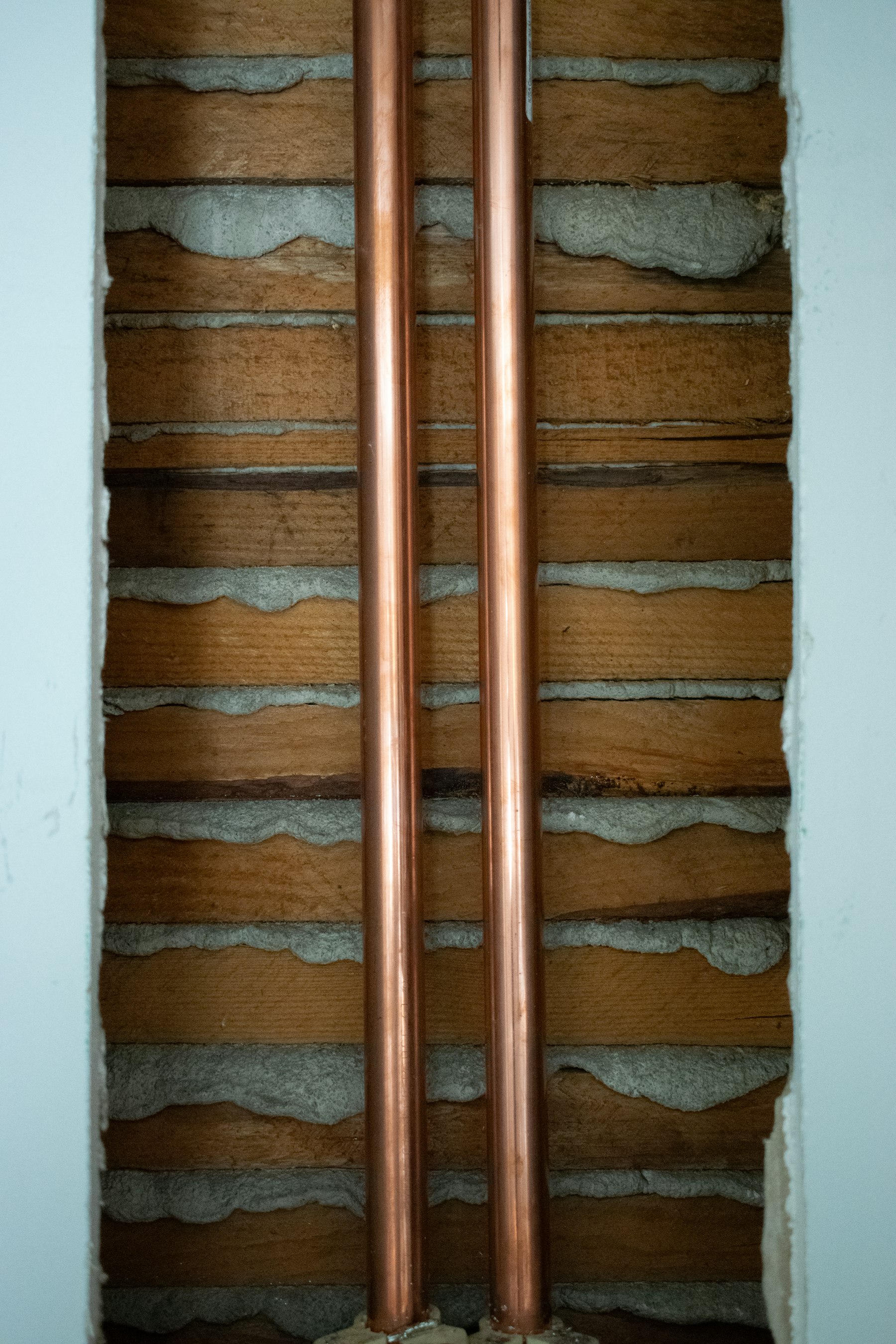
Photo · Kelsey Todd on Unsplash
Water pressure
Where the static water pressure entering the house exceeds 80 psi, a pressure-reducing valve is required — IPC 2024 §604.8 / IRC 2024 §P2903.3.1. The valve must conform to ASSE 1003 and be installed with a strainer downstream of the meter.
Minimum flow pressures at fixtures come from IPC 2024 §Table 604.3 / IRC 2024 §Table P2903.1:
| Fixture | Flow pressure | Flow |
|---|---|---|
| Lavatory | 8 psi | 0.5 gpm |
| Shower | 8 psi | 2.5 gpm |
| Water closet (tank) | 20 psi | — |
| Water closet (flushometer) | 35 psi | — |
| Hose bibb (sillcock) | 8 psi | — |
Cheap ($10) gauge that screws onto a hose bibb reads static pressure at any outdoor faucet. Over 80 psi is a red flag; over 100 psi will eventually rupture washing-machine hoses and fatigue joints.
Traps & vents
Every fixture has a trap — the U-shaped bend under it. The trap holds a water seal that blocks sewer gas from entering the house. Per IPC 2024 §1002.4 / IRC 2024 §P3201.3, the seal depth must be ≥ 2 inches and ≤ 4 inches. Deeper is only permitted where required by design (e.g. certain accessible fixtures).
Every trap must be vented. Without a vent, draining one fixture pulls the seal out of another and lets sewer gas in. Common ways this fails in an older house: an S-trap (no vent above the trap), a "cheater" (unlisted) vent, or a vent stack that's been cut for a remodel and never reconnected.
Water heater safety
Every storage water heater has a temperature-and-pressure (T&P) relief valve. If either temperature or pressure runs away, the valve opens and dumps water instead of the tank exploding. T&P valves are listed under ANSI Z21.22 / CSA 4.4 to open at or before 210 °F and 150 psi — that's the valve's listed setting, not a code section number.
What is enforceable is the discharge piping — IPC 2024 §504.6 / IRC 2024 §P2804.6.1:
- · Full size of the valve outlet.
- · Drains by gravity to a safe location.
- · Terminates between 2 pipe diameters and 6 inches above the floor or receptor.
- · Not directly connected to drainage — must discharge through an air gap.
- · No valves or threaded end on the discharge.
If your T&P discharge is capped, plugged, or trapped, that's a life-safety defect — replace or reconnect it before doing anything else on the heater.
Cross-connection & backflow
A cross-connection is any point where non-potable water could siphon back into the drinking-water supply. IPC 2024 §608 / IRC 2024 §P2902 prohibits them unless protected by an approved backflow preventer or air gap. The most common household examples:
- Hose bibbs without a vacuum breaker — a hose in a bucket of soapy water can back-siphon during a supply pressure drop.
- Handheld shower wands that can reach into the tub water without a check valve.
- Boiler / hydronic system fill lines without a reduced-pressure backflow preventer.
- Irrigation systems without an atmospheric or pressure vacuum breaker.
Air gap for a common lavatory (effective opening ≤ ½ in.) is a minimum of 1 in. from the flood-level rim, or 1½ in. if it's near a wall — IPC 2024 §Table 608.15.1.
Fixture flow limits
Federal maximum flow rates were set by the Energy Policy Act of 1992 (as amended). They cap what a fixture can be sold at in the US, regardless of what your local plumbing code says. WaterSense is the EPA's voluntary label with tighter limits.
| Fixture | Federal max | WaterSense |
|---|---|---|
| Toilet | 1.6 gpf | ≤ 1.28 gpf |
| Showerhead | 2.5 gpm @ 80 psi | ≤ 2.0 gpm @ 80 psi |
| Lavatory faucet | 2.2 gpm @ 60 psi | ≤ 1.5 gpm @ 60 psi |
| Kitchen faucet | 2.2 gpm @ 60 psi | — (not labeled) |
Sources: 10 CFR 430 (EPAct 1992 baseline flows); EPA WaterSense specifications for tank-type toilets, showerheads, and lavatory faucets.
Self-inspection checklist
Walk-through for the whole house. Anything failing → licensed plumber.
Household plumbing walk-through
0 / 11This checklist tracks your progress locally — nothing is saved to a server.
Household water-use calculator
What replacing legacy fixtures with WaterSense equivalents actually saves. Uses AWWA REU2016 use-frequency assumptions and EPA WaterSense / federal flow limits.
Fixture water-use calculator
Compares three fixture generations across toilet, shower, and lavatory faucet. Federal max flows are set by EPAct 1992 / EISA 2007; WaterSense limits are the EPA voluntary specification (linked on the Plumbing page).
| Set | Toilet (gpf) | Shower (gpm) | Faucet (gpm) | Annual (gal) |
|---|---|---|---|---|
| Pre-1992 legacy (conservative) | 3.5 | 3.5 | 2.75 | 99,973 |
| Current federal max (EPAct 1992) | 1.6 | 2.5 | 2.2 | 67,627 |
| EPA WaterSense | 1.28 | 2 | 1.5 | 51,027 |
48,946 gal/year saved
Difference between a full WaterSense fixture set and a pre-1992 house for a household of 4. Doesn't include leaks — the average US household loses about 9,400 gal/year to leaks according to the EPA.
Use-frequency assumptions from AWWA Research Foundation, "Residential End Uses of Water, Version 2" (2016), summarizing national household data.
Codes & standards referenced on this page
| Standard | Section | What it covers |
|---|---|---|
| IPC 2024 | §604.8 | 80 psi maximum static; PRV required above |
| IPC 2024 | §Table 604.3 | Minimum flow pressures at fixtures |
| IPC 2024 | §1002.4 | Trap seal depth 2–4 in. |
| IPC 2024 | §708 | Cleanouts on horizontal drains |
| IPC 2024 | §504.6 | Water heater T&P discharge piping |
| IPC 2024 | §608 | Cross-connection control |
| IPC 2024 | §Table 608.15.1 | Minimum air gap sizes |
| IRC 2024 | §Chapters 25–33 | Residential plumbing (1- and 2-family) |
| IRC 2024 | §P2903.3.1 | Water pressure — PRV threshold |
| IRC 2024 | §P2801.6 | Hot water temperature at fixtures |
| ASSE 1003 | §— | PRV product standard |
| ANSI Z21.22 / CSA 4.4 | §— | T&P relief valve listing (210 °F / 150 psi) |
| EPAct 1992 | §10 CFR 430 | Federal maximum fixture flow rates |
| EPA WaterSense | §— | Voluntary efficiency specifications |
Reminder
This page is guidance, not a permit.
Model codes are adopted (and amended) by each state and municipality. Always confirm the edition in force where you live and pull permits when the work requires it. When in doubt, hire a licensed professional.