Wellness · Hot tubs & spas
Hot tubs & spas
Primary standard: NEC 2023 · Article 680, Part IV
Hot tubs sit at the intersection of three trades — electrical, structural, and water chemistry — and each has its own rulebook. This page walks through the actual code sections and standards each one references, plus a foundation-load calculator so you can size a pad honestly instead of guessing.
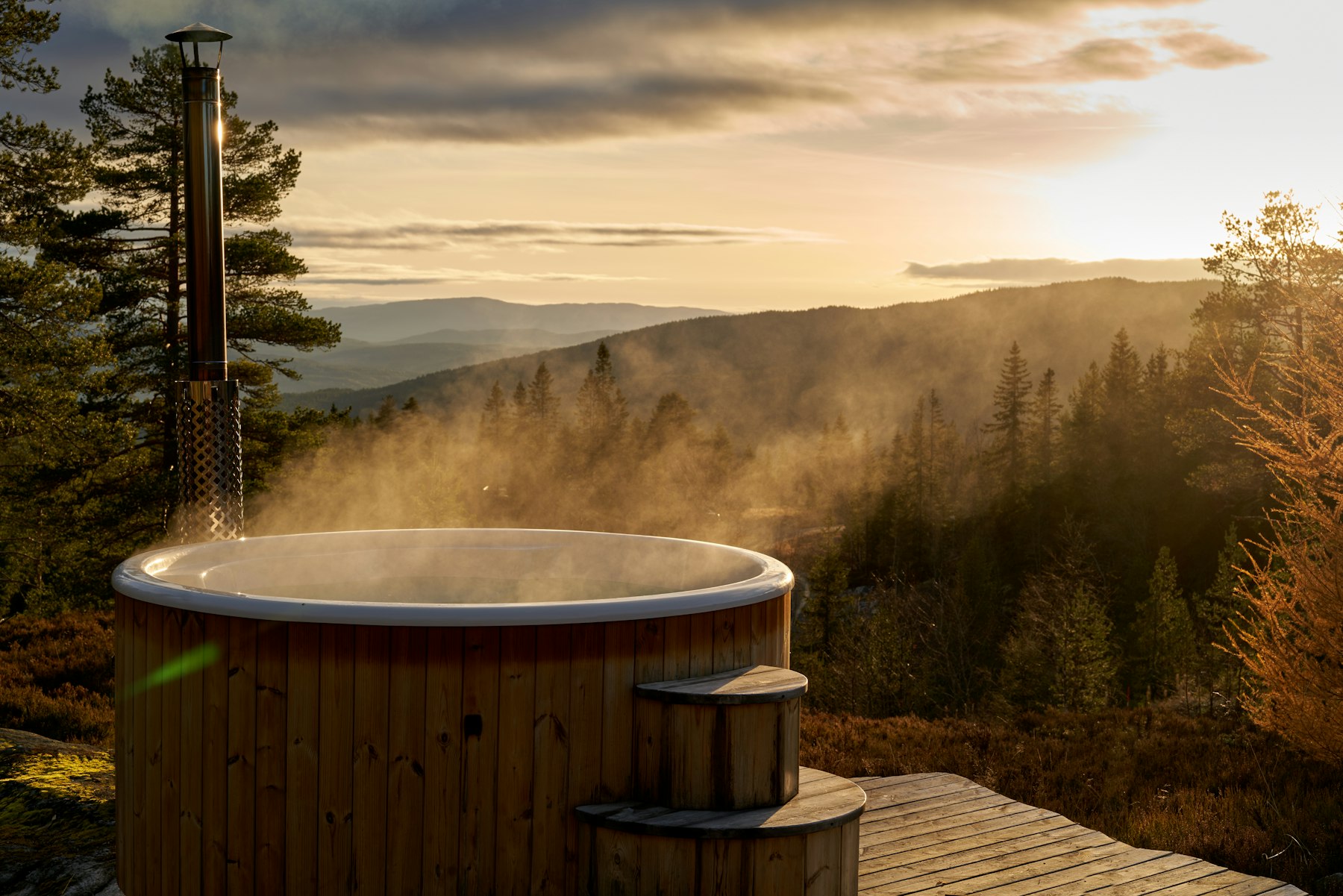
Photo · Barnabas Davoti on Unsplash
Electrical — NEC Article 680, Part IV
The National Electrical Code treats hot tubs and spas as a special occupancy with its own article. Part IV of NEC 2023 §680 covers spas — outdoor at NEC 2023 §680.42, indoor at NEC 2023 §680.43.
- Receptacle setback (outdoor). NEC 2023 §680.42 — a 125 V, 15 or 20 A receptacle is required not less than 6 ft and not more than 20 ft from the inside wall of the spa. Any receptacle within 20 ft must be GFCI-protected.
- Receptacle setback (indoor). NEC 2023 §680.43 — required receptacle 6 ft to 10 ft from the inside wall. Other receptacles within 10 ft rated ≤ 30 A require GFCI protection.
- Disconnect. A readily accessible disconnecting means, in sight of the spa, at least 5 ft away — so a bather can reach it without touching energized equipment. Locking the panel breaker does not count.
- GFCI on the feeder. NEC 2023 §680.44 requires GFCI on all outlets supplying a self-contained, packaged, or field-assembled spa. Exception: a listed self-contained / packaged unit with integral GFCI protection for all its own components is already covered. Cord-and-plug portable units are limited to 15 or 20 A, 125 V single-phase per NEC 2023 §680.42(A)(2).
- GFCI trip level. A Class A GFCI trips at 6 mA within approximately 25 ms (must not trip below 4 mA). This is the UL 943 §Class A personnel-protection standard — the same device you'd see on a bathroom receptacle.
Equipotential bonding — 680.26
Bonding is the reason a hot tub is safe even when everything around it is wet. The goal is to keep every metal surface, every wet surface, and the water itself at the same electrical potential so a person can't become part of a current path.
NEC 2023 §680.26 requires bonding of the shell's metal parts, perimeter surfaces within 3 ft horizontally of the spa, metal fittings, pump and motor housings, metal raceways and piping, ladders, and luminaires. The bonding conductor must be ≥ 8 AWG solid copper — insulated, covered, or bare. When a perimeter grid is used, it is 8 AWG on a 12″ × 12″ grid tied to the equipotential bond.
Bonding is not the same as grounding. Bonding equalizes; grounding provides a return path to earth. Both are required. A hot tub installed without bonding can pass a plug-in leakage test and still be a lethal step-potential hazard.
Foundation & base
Manufacturers universally require a level, non-flexing surface. There are three common approaches:
- Reinforced concrete slab. Minimum 4″ thick at 3,500–4,000 psi. 6″ is commonly specified for larger tubs or expansive/soft soils. Reinforce with #3 or #4 rebar on a 12–18″ grid (or 6×6 W1.4×W1.4 welded wire mesh), chaired to mid-slab depth. Full 28-day cure before installation.
- Compacted paver base. Per the ICPI / CMHA hardscape guide spec (PAV-GSP-004-21): 4–6″ of compacted crushed stone, compacted to ≥ 95% Standard Proctor (ASTM D698) for cohesive soils, or 95% Modified Proctor (ASTM D1557) for granular soils. Pavers set on a 1″ bedding course of ASTM No. 8 stone, with edge restraint on all sides.
- Manufactured spa pad. Interlocking polymer pads (Handi-Spa, EZ Pad, etc.) sit on a compacted base. Fastest install, works for many models — but check whether your specific manufacturer accepts it before you commit.
A filled 7'×7' hot tub with four bathers weighs roughly 4,000–5,000 lb. Distributed over 49 ft², that's under 100 psf — but concentrated at the corners it can be much higher. Use the calculator below to sanity-check your specific model.
Water chemistry
Numbers below are the Pool & Hot Tub Alliance's recommended ranges for residential spas. Public and commercial spas fall under the CDC's CDC MAHC 2023 (4th ed.) with tighter continuous-monitoring requirements.
| Parameter | Ideal | Min | Max |
|---|---|---|---|
| pH | 7.4 – 7.6 | 7.2 | 7.8 |
| Free chlorine (ppm) | 3 – 5 | 2 | 10 |
| Total bromine (ppm) | 4 – 6 | 2 | 10 |
| Total alkalinity (ppm) | 80 – 100 | 60 | 180 |
| Calcium hardness (ppm) | 150 – 250 | 100 | — |
Source: PHTA Recommended Water Chemistry Parameters (residential spa). High alkalinity buffers pH; high calcium hardness prevents plaster and heater-element damage. Test 2–3× per week if the spa sees regular use.
Self-inspection checklist
Run this before every season and after any electrical work on the spa or nearby.
Hot tub / spa walk-through
0 / 10This checklist tracks your progress locally — nothing is saved to a server.
Load & base check
Filled-and-in-use weight vs. typical base capacities. Use this before you pour anything or start moving pavers.
Hot tub load & base check
Estimates filled-and-in-use weight and gives you the cited spec sheet for the exact base you're planning to build.
Step 1 · The tub
Step 2 · The base
Slab specification
4,928 lb total · 101 psf · base rated ~3,000 psf
Comfortably under this base's capacity. Safe as a residential build — always subject to manufacturer approval and local soil conditions.
Best-practice spec sheet
Or 6×6 W1.4×W1.4 welded wire mesh, chaired to mid-slab.
Consult your county's frost-depth table.
Reference: manufacturer consensus and ACI 332 (Residential Concrete) workmanship practices. 6″ slabs are commonly specified for larger swim-spa units or expansive/soft soils.
Water weight uses 8.345 lb/gal (fresh water, ~60 °F). Average bather assumed 185 lb, roughly the US adult mean from CDC anthropometric data. Capacity numbers are consensus values from Interlocking Concrete Pavement Institute (ICPI) / CMHA and Pool & Hot Tub Alliance (PHTA) installation guides. Your soil, frost line, drainage, and manufacturer specifications override all of this.
Codes & standards referenced on this page
| Standard | Reference | What it covers |
|---|---|---|
| NEC 2023 (NFPA 70) | Article 680, Part IV | Spas and hot tubs — general |
| NEC 2023 | 680.42 | Outdoor installations — clearances, GFCI, disconnect |
| NEC 2023 | 680.43 | Indoor installations |
| NEC 2023 | 680.44 | GFCI required on spa feeders |
| NEC 2023 | 680.26 | Equipotential bonding — perimeter grid, 8 AWG Cu |
| ANSI/APSP/ICC-3 | 2014 (R2023) | Permanently installed residential spas and swim spas |
| ANSI/APSP/ICC-14 | 2019 | Portable electric spa energy efficiency |
| UL 943 | Class A | GFCI trip characteristics — 6 mA / ~25 ms |
| ICPI / CMHA | PAV-GSP-004-21 | Interlocking concrete paver guide spec — base, bedding, edge restraint |
| ASTM D698 | Standard Proctor | Compaction test for cohesive soils (clay, silt) |
| ASTM D1557 | Modified Proctor | Compaction test for granular soils (sand, gravel) |
| ACI 332 | — | Residential Concrete — slab thickness, mix design, cure time |
| ASTM F1346 | — | Safety cover standard for spas and pools |
| PHTA | Recommended Water Chemistry | Residential spa pH, sanitizer, alkalinity, hardness |
| CDC MAHC | 4th ed. (2023) | Model Aquatic Health Code — public spas / pools |
Reminder
This page is guidance, not a permit.
Model codes are adopted (and amended) by each state and municipality. Always confirm the edition in force where you live and pull permits when the work requires it. When in doubt, hire a licensed professional.